I once planted a trio of hazelnut trees on my property in Pennsylvania, setting them in a triangle about 15 feet on a side around a enormous rock roughly the…
I once planted a trio of hazelnut trees on my property in Pennsylvania, setting them in a triangle about 15 feet on a side around a enormous rock roughly the size of a VW Beetle. One year in late August, when the trees were about five years old and 15 feet tall, their tops finally reached each other and formed a leafy canopy that shaded the rock beneath.
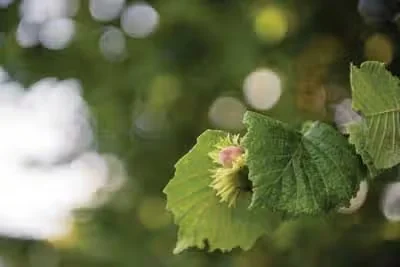
This was the time in late summer when filberts, as hazelnuts are also called, are ripe enough to pick, so I grabbed my six-year-old daughter and a large woven white-oak basket and headed out to the tall bushes to go a-nutting, as country folks used to say.
"Do you see any nuts?" I asked her. She looked all around, but after a few minutes declared that there were no nuts. Sensing a teachable moment, I told her we had to sit down and wait patiently, and eventually the nuts would appear. She looked at me skeptically. After a few more minutes, though, she spotted one—or, rather, two fringed, green husks where the nuts reside, hanging like a pair of narrow-mouthed bells just under a clutch of leaves. And then she saw another. And another, until finally she realized the bushes were absolutely loaded with nuts.
Unfortunately, the squirrels had no trouble spotting the nuts either. And for the next couple of years, they beat me to the crop, literally stealing every last nut. Frustrated and fuming, I grabbed my .22 rifle and sat on the rock. I remember what I hollered: "Okay squirrels, listen up! You see this rifle? If you swipe all these filberts, I'm going to shoot you dead. But I'll make you a deal. If you leave me at least half the nuts, I won't shoot you. Guaranteed!"
To my surprise, it worked. From then on, we had plenty of our own sweet hazelnuts and so did the squirrels. Those trees—by then they were tall and rangy, maybe 20 feet tall or more—produced magnificent crops. My half of the harvest filled the oak basket every year. Imagine my delight then, while walking down my quarter-mile-long rocky driveway, when I noticed bushes along the side that looked very much like my hazelnuts, only in miniature, just four feet tall. On closer inspection, I could see little husks and nuts hanging among the leaves and branches. I'd discovered the wild hazelnut, Corylus americana, growing right on my own property.
But there's always trouble in paradise, it seems. Those wild hazelnut bushes carry a fungus, Anisogramma anomala, commonly known as eastern filbert blight, that doesn't do much damage to native wildings like C. americana and the Western-native beaked hazelnut, C. cornuta, but aggressively destroys the commercial nut-bearing hybrids, usually within 10 years. Those hybrids are crosses of the northern European native C. avellana and southern European C. maxima. As European natives, they didn't co-evolve with the filbert blight fungus and have no natural resistance. The blight also attacks C. avellana 'Contorta'—or Harry Lauder's walking stick—a twisty, curvy ornamental that I also grew in my Pennsylvania landscape.
I never saw blight on either my nut trees or Harry Lauder, but I moved to California about the time the filberts reached 12 years old and were due for infection. On a return visit to the property about a decade later, the filberts I'd planted were gone, but the wild bushes along the driveway were charming as ever.
Fighting the Blight Whether you call them hazels or filberts, they grow wild and as cultivated varieties across nearly all of North America. In fact, the commercial hazelnuts we find in stores are mostly grown in Oregon and Washington on the same hybrids I'd planted back in the Mid-Atlantic region. Oregon's Willamette Valley produces about 98 percent of the filberts in commerce in the United States.
Unfortunately, eastern filbert blight has now made its way to the Pacific Northwest and is attacking the major plantings in the Willamette Valley. Growers estimate that yields will be down about 20 percent this year, due to the need for pruning out infected wood. Unlike most fungi that attack woody plants through wounds in the bark, EFB, as it's known, infects new growth, especially as the shoots are elongating in the spring. It spreads by raindrop splash, wind and by the orchardist who isn't careful about disinfecting tools, or disinfecting hands after touching infected wood.
There is no cure for EFB. If you want to plant for nut production, search online for the cultivars of nut-bearing resistant hybrids called 'Jefferson', 'Santiam', 'Yamhill' or 'Theta'. 'Red Dragon' is a resistant ornamental cultivar. Dr. Thomas Molnar at Rutgers in New Jersey is doing excellent breeding work for resistant cultivars. The hazelnut-breeding program at Oregon State University, directed by Dr. Shawn Mehlenbacher, uses the genetic diversity in the genus Corylus to create new EFB resistant cultivars for the Oregon industry. The cultivars 'Lewis', 'Clark', 'Gem' and 'Sacajawea' show good resistance across several genes, while 'Santiam', 'Yamhill', 'Dorris', 'McDonald' and 'Jefferson' have a single dominant resistance gene. 'Jefferson' especially shows promise. It may develop a few stromata (spore-producing black fungus patches on the bark) but not enough to kill the plants. And the stromata tend to disappear after a few years. Still, it will be wise for those who plant 'Jefferson' to prune out infected branches because they may spread the disease.
EFB kills by girdling the bark and destroying the cambium. It doesn't infect the leaves, flowers, catkins or nuts, however. The best time to check your filberts for infection is winter, when the leaves are gone and the bark is easy to examine. The fungus produces black, rough patches in discrete lesions on the bark, especially on young wood. If you find some infected branches, prune them two to three feet below where you spot the first canker. Disinfect your pruners in 10-percent bleach or 70-percent alcohol solution between cuts, allowing them at least 30 seconds in the solution and letting them air dry. Pruned branches should be burned, buried deeply in a pit or chipped and allowed to dry well before burning or removing. Make sure you aren't transferring fungus on your hands or clothes as you do this work. If a filbert is so badly infected that it would need too heavy a pruning, remove the whole plant. Don't be shy about being relentless with this disease.
Easy-care Trees Other than the blight problem, filberts are one of the easiest nut trees you can grow. They prefer well-drained soil of moderate fertility. Too rich a soil gives you an abundance of wood and leaves but sparse flowering. They spread by underground roots, sending up many suckers, so if you want a single-trunked tree, you'll have to keep cutting off the extra shoots and suckers that pop up from the roots each year. Nut production is best, of course, if you let multiple stems grow into trunks with fruiting branches.
Filberts develop a taproot as well as underground runners, so after about three years they really don't like being moved. Taproots also don't do well in constricted containers, where they'll just curl around and around, so filberts aren't candidates for growing in pots.
Prune to keep the stand open and airy, especially if you're letting plants become multi-trunked. Breezes help with pollination. If you're planting more than one cultivar, make sure your choices' catkins are shedding pollen at the same time flowers are opening. Remove trunks if the stand gets too crowded with lots of crossing branches. Take out whole suckers and trunks; don't cut back the upright shoots. Plant in full sun, although they will tolerate partial shade if it isn't too deep.
Harvest and Enjoy Harvest the paired husks and nuts when ripe, around Labor Day. Spread them on a tarp where squirrels can't get at them and shell the nuts out of the husks as time permits. When first harvested, the nuts inside their shells are unpleasantly moist and need to dry out over the next few months—a process called curing. My homegrown filbert nuts invariably developed a little greenish mold on the more porous part of the shell as they cured during September through November and moisture escaped, but I never noticed any loss of quality in the nuts inside. I believe the small amount of mold was just on the surface of the shell. Commercial hazelnuts are given a mold-prevention treatment with sulfur dioxide. If you want to prevent mold on your homegrown nuts, pick up a bottle of Campden tablets at your winemaking-supply shop (or online). Dissolve a couple of 50-mg tabs in a quart of water, dip the nuts in the water, let them dry and they'll be mold free. The tablets release sulfur dioxide that kills mold spores.
Hazelnuts are champions when it comes to percentage of monounsaturated fat. Nearly 80 percent of the oil is monounsaturated. Gourmets use the expressed oils for salad dressing—a little goes a long way. The delicate flavor of the oil is quickly ruined by heat, so it's not a cooking oil. And it tends to go rancid quickly, so buy it in small quantities. To get the best flavor, lightly roast the shelled nuts. Their flavor harmonizes beautifully with coffee and chocolate—although I can't stand the so-called hazelnut-flavored coffee that tastes like a chemical knockoff of the real thing. I do love the ground hazelnut and chocolate spread called Nutella (but who doesn't?).
In the fall, after they've cured, you can store them in the freezer for up to a year, so you can always have fresh-tasting nuts on hand. You'll find that a pound of hazelnuts in the shell equals about a cup and a half of shelled nutmeats, and that one cup of whole shelled nuts is about five ounces. My favorite way to use them is in a hazelnut torte. Use only hazelnuts put through a hand-cranked nut shredder, and flavor it with melted dark chocolate. Serve a slice with a cup of espresso. Now that's perfection.
Jeff Cox gardens in the Sonoma Valley of California.
Image credit: Fabio Pagani/EyeEm/Getty Images
More from Home
Uncommon Herbs to Grow at Home
Most of us, when we think of culinary herbs, automatically picture the Mediterranean staples: basil, mint, oregano, thyme, sage,…
Growing Beans in the Home Garden
Beans are one of the most rewarding crops you can grow at home—honest, they practically take care of themselves. Here's what I've…
How to Grow Scallions in a Home Garden
Scallions—green onions, spring onions, whatever you call them—are one of those kitchen staples I always want within arm's reach.…