It's late May, and here I am bundled up in a down jacket, fleece-lined leggings, waterproof pants, and a rain poncho for an outdoor workshop on no-till methods…
It's late May, and here I am bundled up in a down jacket, fleece-lined leggings, waterproof pants, and a rain poncho for an outdoor workshop on no-till methods at Seeds of Solidarity Farm and Education Center in Orange, Massachusetts. Deb Habib and Ricky Baruc have been farming and teaching carbon-conscious gardening here for over twenty years. The forecast says 46 degrees, wind, and rain—and honestly, I wouldn't miss it.
Crazy thing is, just two days earlier it had pushed into the 90s, and it'll climb back up soon enough. Five other brave souls have shown up to learn no-till techniques, each of us wanting to be part of the solution to turn climate change around.
So how can backyard gardeners and small-scale farmers actually move the needle? Here's the beautiful part: plants pull carbon dioxide from the air and send more than half of it down through their roots as sugars, where a whole underground community—arthropods, nematodes, fungi, protozoa, and bacteria—stores it away. In return, those organisms feed micronutrients back to the plants. More life underground means more nutritious vegetables on your plate. A single teaspoon of soil holds billions of beneficial microbes, each one locking away carbon. Leave that soil undisturbed—no tilling, no dousing with synthetic chemicals—and tons of carbon can stay put for centuries.
According to Dr. Rattan Lal of Ohio State University, “a mere 2 percent increase in the carbon content of the planet’s soils could offset 100 percent of all greenhouse gas emissions going into the atmosphere.”
That means we need all hands on deck—the world’s 500 million large-scale farmers, 700 million smallholders, and every last one of us backyard gardeners—sequestering carbon at up to two tons per acre.
Gardening With Cardboard
“Interest in no-till has gone from ‘who does this?’ to ‘how do I do this?’” Deb Habib tells us with a grin. Today she and Ricky Baruc will walk us through three planting methods, and cardboard is the star of every single one. Their passion for cardboard has only grown over the years—right alongside their greenhouses, fields, and raised beds.
We're standing at the edge of a garlic field that was planted into a cover crop knocked down with silage tarp—a heavy black plastic that blocks sunlight and stops weeds and growth in their tracks.
“Till that cover crop and you erase it,” Baruc says. “Tilling just brings weed seeds to the surface and keeps the cycle going. Silage tarp knocks out the weeds, sure. But it doesn’t build soil.” Cardboard does. Use it consistently, he promises, and “the soil will be richer next year than it was this year.”
“No-till is an incredible labor saver,” he adds. “No more hours spent plowing or running the rototiller.” And there's more: “Farm equipment compacts the soil so water can’t soak in. When you plow, you’re disturbing and killing off the very life that makes soil healthy.”
By now the rain has eased up, and we get to work laying down cardboard and shoveling compost on top.
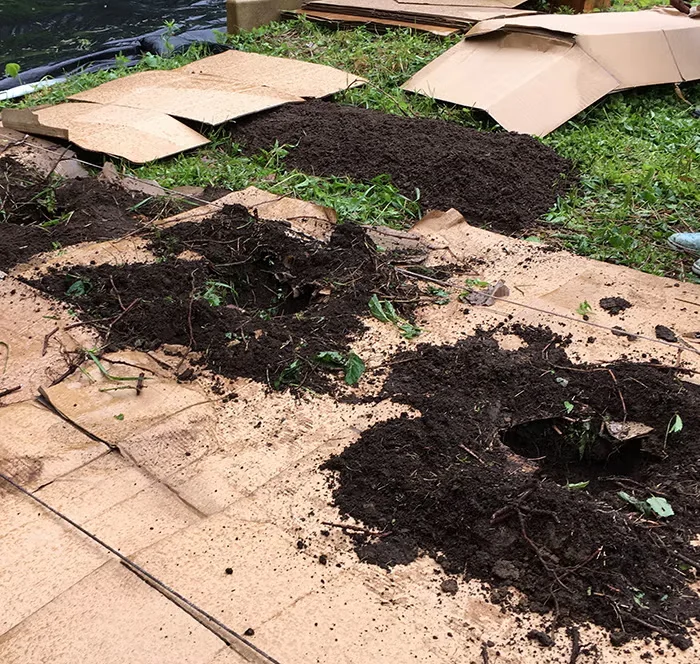
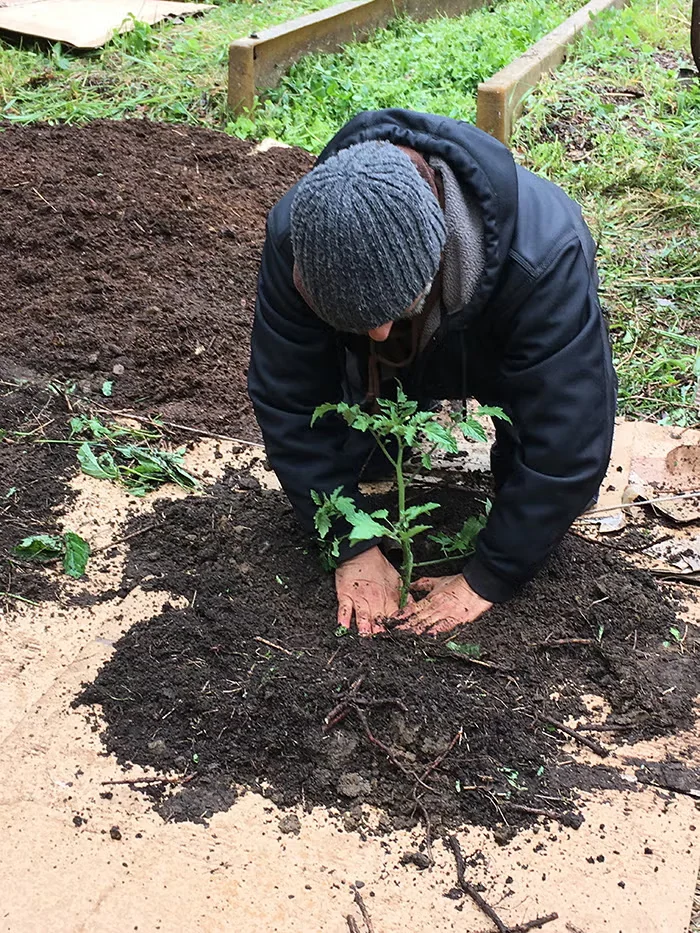
Method #1 is for large seedlings: Two of us lay big sheets of cardboard right over the weedy ground, then cut holes about a foot across, fill each one with well-aged compost, and plant a tomato seedling. We press the soil down firmly to create a shallow basin around each plant so rainwater will collect right where it's needed.
Method #2 handles small seedlings: We spread compost right onto the untilled ground, lay cardboard over it, give it a good soaking to soften things up, and top it with aged wood chip mulch. Then Baruc uses a dibble stick—basically a pointed wooden dowel—to punch holes about two inches across through the cardboard, and tucks bok choy seedlings into each one.
Method #3 is for direct seeding: If the ground is dry, wet it down first. Lay cardboard directly on the untilled soil, wet the cardboard thoroughly, and spread compost on top. Then sow or scatter your seeds right into the compost.
Inside one of the greenhouses, Baruc peels back damp, crumbling cardboard to reveal hundreds of worms wriggling beneath. They feast on the cardboard, multiply like crazy, and leave behind carbon-rich castings while they aerate and loosen the soil.
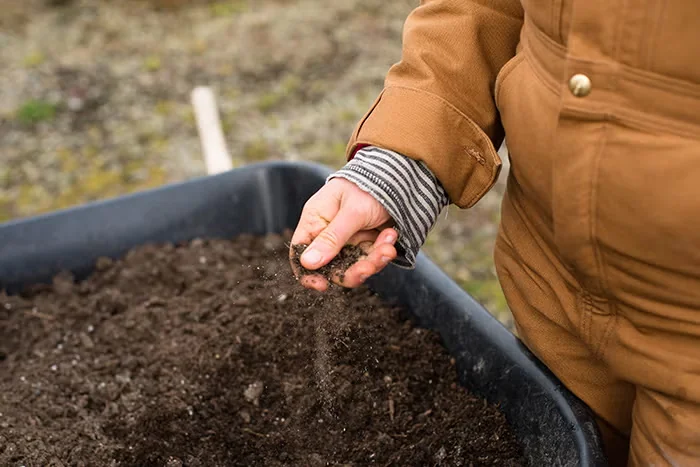
“Best worm food there is? Cardboard,” he declares. “And the best plant food? Worm poop.” He scoops up a handful of fluffy, dark, carbon-rich soil as proof.
I make a mental note to come back on a sunny day—take my time, get some decent photos, and really soak in the quiet charm of this modest two- to three-acre farm.
Four days later, the sun is out and it's warm. I stroll down the farm road past fields bursting with growth, pausing to read the hand-painted signs scattered along the way. One carries a line from Rumi: “Let the beauty we love be what we do.”
The crops are practically glowing in the late afternoon light as I find Habib, who's set aside this time to chat. She's bent over one of her raised beds, transplanting flower seedlings she started in the greenhouse. Her bare hands work the soil, gently tamping each little plant into place.
“How do you get soil this beautiful?” I ask her.
“I layer on compost and keep cardboard on top through the whole winter,” she answers. “For perennials, you just cut and fit the cardboard around them.”
Then she reaches down and yanks out a big dock weed—barely any effort at all! Normally that stubborn taproot clings for dear life, but in this soil it slides right out, root and all, like pulling a carrot.
Habib mentions that a lot of gardeners come to her asking about pest control.
“Really, the question ought to be ‘how do I build healthy soil?’” she says. “Do that, and everything else follows—a more beautiful garden that helps fight climate change, supports a diverse ecosystem, conserves water, grows plants that naturally resist pests, and saves you work.”
“Ricky handles the farm side, and I run the nonprofit,” she explains. They bring their message to health centers, prisons, and garden clubs, guiding folks of every age to “work with nature, not against it. Our tagline is Grow Food Everywhere.” Her advice to newcomers? “Start small, be successful, and grow from there.”
During the pandemic, she says, “a lot of folks tried gardening for the first time, and it can feel overwhelming. But with no-till and cardboard, you don’t have to weed and water the way you used to.” And the gardener gets something back, too: “There are bacteria in soil that trigger serotonin release,” she explains. “Growing plants is genuinely therapeutic.”
As we walk up the road, we run into Baruc standing beside a sign that bears the Indigenous Elders and Medicine People's Council statement from the United Nations Convention on Climate Change. He reads it to me slowly, with real reverence:
“To date, the sacred has been excluded from all discussions and decisions. To survive climate change and see the future we must heal the sacred in ourselves and include the sacredness of all life in all discussions, decisions and actions.”
I ask him what those words mean to him personally.
“If you’re treating the soil as sacred,” he says, “you don’t destroy it by tilling and killing the life in it. If it weren’t for 12 inches of soil we wouldn’t be here. It’s imperative that we grow food and wake up to indigenous wisdom.”
The low sun paints a golden glow across a field of garlic that Baruc planted by hand. For decades now, starting from scratch on forested land nobody thought could be farmed, he and Habib have built a living without ever turning the soil. They believe the world needs more small farms—“for food access and to create more carbon sinks,” as Baruc puts it. Their approach doesn't require expensive equipment, which means more young people can realistically give farming a shot. Their mission: teach others to regenerate the soil, grow nutrient-dense food, and lock away tons of carbon for the long haul.
More from Build
Compact Edible Plants for Small-Space Gardens
Picture this: you're on your back patio, and you reach over to pluck a sun-warmed cherry tomato from a plant barely eight inches…
Uncommon Herbs to Grow at Home
Most of us, when we think of culinary herbs, automatically picture the Mediterranean staples: basil, mint, oregano, thyme, sage,…
Grow Blueberries and Their Relatives to Benefit the Garden and Your Health
Isn't it something how the simple things we love as kids end up opening into whole worlds of discovery as we get older?…