Landscape architect and edible-landscaping expert Brian Barth shares his advice for growing feijoa, or pineapple guava—a tropical-tasting fruit that asks…
Landscape architect and edible-landscaping expert Brian Barth shares his advice for growing feijoa, or pineapple guava—a tropical-tasting fruit that asks surprisingly little of the gardener:
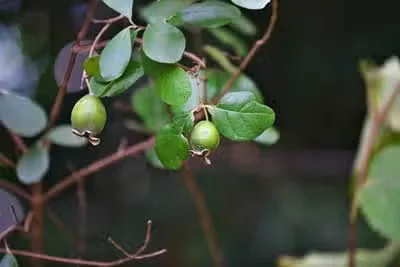
I met my first feijoa (Acca sellowiana) at a farmer's market stall shortly after moving to Santa Cruz, Calif. in the '90s. Also known as pineapple guava, feijoa is widely grown in Mexico and Central America, but it's been planted all along the West Coast for the last hundred years and, more recently, on a limited scale in the southern United States. These tough plants survive temperatures down to about 10˚F and do just fine on modest seasonal rainfall, so you could fairly call them a Mediterranean species in the horticultural sense—even though they actually originate in the Americas.
Visually, feijoas slot right in beside figs and olives—ruddy oblong fruits, shaggy pale bark, and deep green matte leaves that flash a fuzzy gray underside whenever a breeze catches them. You can grow them anywhere figs and olives thrive, but feijoas are just as easy to keep at shrub size, and you can even bring them indoors for winter just like potted citrus.
In California, feijoas are one of the most popular hedge plants around, planted widely just for their looks. After I shelled out $5 for a tiny basket at that farmer's market, I started noticing the fruit rotting on the ground all over town. Since then, I've harvested bushels of feijoas from fast-food parking lots and city parks—free for the taking! They mature in October and November, giving you a bright burst of tropical flavor right before winter settles in. Just slice one in half and scoop out the soft flesh with a spoon; it's that easy.
Growing Feijoa Feijoas make a handsome 6- to 8-foot privacy hedge, though to really appreciate their beauty, you'll want to grow them as a small tree. Train them to a single trunk right from the seedling stage and they'll grow into a flat-crowned savannah tree with a naturally picturesque branching pattern—hardly any extra pruning needed. At up to about 15 feet tall, they make a gorgeous focal point for a patio garden. If winter means moving them inside, no worries—grow them in tree form in a 20-gallon tub and keep them pruned to about 6 feet so they'll fit through the door.
If the fruit is fall's tropical surprise, the flowers are spring's answer. They open each May, thick white petals curving back to show off a cluster of crimson stamens, and they scent the air like sweet chai tea—as if the plant wasn't already gorgeous enough in leaf, form, and fruit! And here's the kicker: the flowers are edible. Unlike most edible petals, which run from bland to outright bitter, feijoa petals have a subtle cinnamon flavor that feels silky and sweet on the tongue. Toss them with the pulp in fruit salads or desserts and you've got something special.
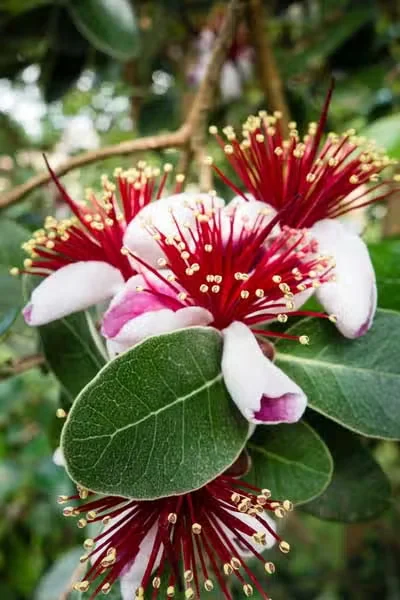
Most feijoas are only partially self-fertile, so you really need to plant more than one—especially if you're working with the unnamed seedlings commonly sold as hedge stock. Named cultivars like 'Nazemetz', 'Coolidge', 'Nikita', and 'Mammoth' give you larger fruit (up to four inches long, double the size of typical seedling fruit) with consistent flavor and quality. If you've only got room for one, go with 'Coolidge'—it's the only reliably self-fertile variety.
Feijoas are virtually immune to pests and diseases, though powdery mildew can show up if they don't get a full day of sun or sit in overly damp soil. Honestly, they're one of the easiest fruiting shrubs you can grow—and one of the least known. If you buy a cultivar or two and decide you want a whole hedge, try ground layering. Softwood cuttings will root eventually in a misting house with bottom heat, but it's far simpler to bend the lowest branches down and stake them beneath the soil until roots form. Then just slice them off with a sharp spade and move them wherever you like.
Fruit photo credit: igaguri_1 / iStock / Getty ImagesFlower photo credit: cber969 / iStock / Getty Images
More from Feijoa
Compact Edible Plants for Small-Space Gardens
Picture this: you're on your back patio, and you reach over to pluck a sun-warmed cherry tomato from a plant barely eight inches…
Uncommon Herbs to Grow at Home
Most of us, when we think of culinary herbs, automatically picture the Mediterranean staples: basil, mint, oregano, thyme, sage,…
Grow Blueberries and Their Relatives to Benefit the Garden and Your Health
Isn't it something how the simple things we love as kids end up opening into whole worlds of discovery as we get older?…